AQSA
The problem
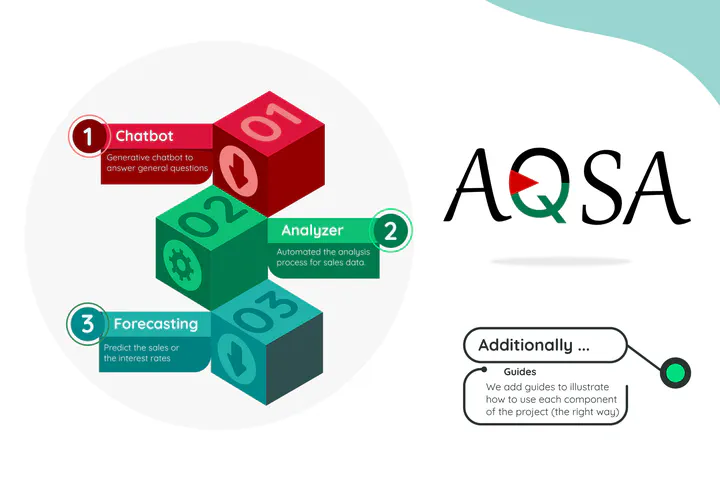
Early-stage founders rarely have a research budget, a forecasting tool, or a team that can build a chatbot on day one — yet they need the same category of decision support that funded startups take for granted. AQSA (“AI for Startups”) was our research project’s answer to that gap: a single concept bundling three things a startup might otherwise assemble piecemeal — a generative chatbot for founder-facing Q&A, an automated data analyser, and a forecasting module.
Constraints
This was a research project, not a funded engineering effort: one semester, a small team, no production users, and no access to real startup data at scale. That shaped the project from the start — the deliverable was a coherent system design and a working proof-of-concept, not a hardened product with measured business outcomes. Being precise about that distinction matters more to me now than it did at the time.
What I did
My focus was the product and system framing: defining what each of the three modules needed to do for a founder, how they’d hand information to one another (chat → analysis → forecast, and back), and where the practical limits of a semester project sat. I worked through the startup workflows the tool was meant to support, and helped shape the analyser and forecasting pieces into something concrete enough for the team to prototype against, alongside the generative chatbot component.
What I’d credit
The project’s real output was the concept and prototype, not a validated product — it’s an archived research effort, and I don’t have production metrics to point to. What it did give me was an early, hands-on look at how the three pillars I still care about — conversational AI, forecasting, and data-driven decision support — fit together as a single system, which is a good part of why I frame my current work the way I do now.
Documented in more depth in the published research report.